Indo-Pacific: The New Global Power Chessboard. Article by – Ayush Srivastava
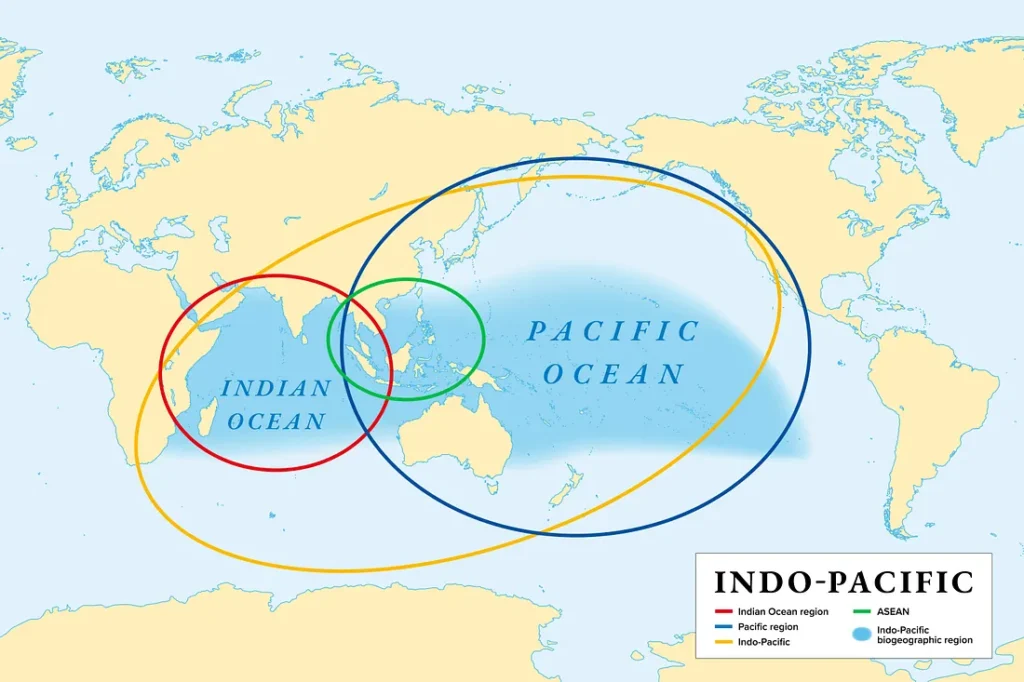
In the 21st century, the centre of global power is steadily shifting toward the Indo-Pacific, a vast region stretching from the eastern coast of Africa to the western shores of the Americas. Home to over 60% of the world’s population and nearly half of global economic output, the Indo-Pacific has become the most consequential geopolitical theatre of our time. Nearly half of the world’s maritime trade and around 40% of global oil shipments pass through its waters, making its sea lanes the arteries of the global economy. As major powers expand their economic, political, and military influence in this region, the Indo-Pacific increasingly resembles a high-stakes chessboard, where each strategic move could reshape the future global order.
The Strategic Significance of the Indo-Pacific
The Indo-Pacific’s importance lies primarily in its economic and demographic weight. The region is home to over 60% of the world’s population and contributes more than half of global GDP, making it the engine of global economic growth.
Furthermore, the region accounts for nearly 46–50% of global merchandise trade and dominates global maritime transportation routes. Strategic sea lanes such as the Strait of Malacca, the South China Sea, and the Indian Ocean shipping routes carry a significant share of global trade and energy supplies. Any disruption in these maritime corridors can have immediate consequences for the global economy.
The Indo-Pacific is also critical for energy security. Approximately 40% of the world’s oil shipments pass through this region, while around 50% of global trade flows through its maritime routes.For countries like India, these sea routes are lifelines, carrying nearly 90% of its trade and 80% of critical freight such as coal, petroleum, and fertilizers.
Great Power Rivalry in the Region
The Indo-Pacific has emerged as the central stage for great power competition, particularly between the United States and China. China’s growing economic and military capabilities, along with initiatives such as the Belt and Road Initiative (BRI), have significantly expanded its influence across Asia, Africa, and the Pacific islands.
In response, the United States and its allies have strengthened strategic partnerships and alliances. Initiatives such as the Indo-Pacific Economic Framework (IPEF) comprising 14 partner countries representing about 40% of global GDP and 28% of global trade ,aim to deepen economic cooperation and counterbalance China’s regional influence.
Similarly, the Quadrilateral Security Dialogue (QUAD) involving India, the United States, Japan, and Australia has gained prominence as a platform for promoting a free, open, and rules-based Indo-Pacific. Through joint naval exercises, technology cooperation, and infrastructure development, these countries seek to ensure stability and maintain a balance of power in the region.
India’s Strategic Role
India occupies a central geographic and strategic position in the Indo-Pacific. With a coastline of over 7,500 kilometres and a vast Exclusive Economic Zone (EEZ), India is deeply connected to the region’s maritime dynamics.
India’s Indo-Pacific vision is based on principles such as freedom of navigation, respect for sovereignty, and inclusive regional cooperation. Initiatives like “Security and Growth for All in the Region” (SAGAR) and participation in multilateral frameworks demonstrate India’s commitment to ensuring stability and economic connectivity across the region.
Moreover, India’s rapidly growing economy and expanding naval capabilities strengthen its position as a balancing power between competing geopolitical blocs.
Emerging Security Challenges
Despite its economic promise, the Indo-Pacific faces several security challenges. Territorial disputes in the South China Sea, tensions across the Taiwan Strait, nuclear issues on the Korean Peninsula, and piracy in parts of the Indian Ocean all contribute to regional instability.
The militarization of strategic waterways and the establishment of overseas military bases by major powers have intensified geopolitical tensions. As a result, the Indo-Pacific has become a critical arena where military deterrence, diplomatic engagement, and economic diplomacy intersect.
The Future of the Indo-Pacific
The Indo-Pacific will likely shape the global order for decades to come. The region’s economic dynamism, technological innovation, and strategic location ensure that it will remain central to global politics and trade. Analysts even project that the region’s share of global GDP could rise to around 42% by 2040, highlighting its long-term economic significance.
However, the future stability of the Indo-Pacific will depend on the ability of regional and global powers to manage competition responsibly. Cooperation in areas such as maritime security, climate change, digital trade, and infrastructure development will be essential to prevent conflicts and ensure sustainable growth.
Checkmate or Cooperation?
As the Indo-Pacific continues to evolve into the epicentre of global geopolitics, the choices made by major powers will define whether the region becomes a zone of conflict or a model of cooperation. While strategic rivalries, particularly among leading economies and military powers, are intensifying, the deep economic interdependence within the region makes outright confrontation costly and unsustainable. With over 60% of global trade flows and critical energy routes passing through these waters, stability in the Indo-Pacific is no longer a regional concern ,it is a global necessity. The real question, therefore, is not who dominates the chessboard, but whether nations can move beyond zero-sum thinking to build a framework of shared security and inclusive growth. In this unfolding game, the ultimate victory may not lie in delivering a checkmate, but in ensuring that the game itself continues without conflict.