“Seva Parmo Dharma”
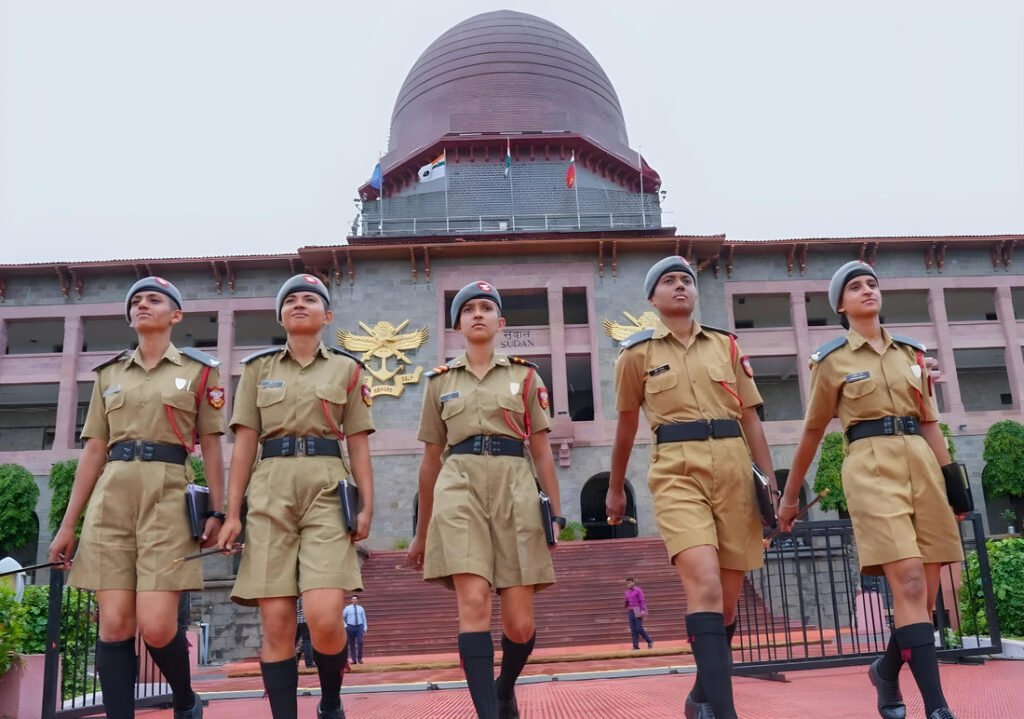
The National Defence Academy (NDA) is India’s premier military training institute for the Army, Navy, and Air Force cadets. Located at Khadakwasla, Pune, the NDA is the only academy in the world where all three branches of the armed forces train together, building unity and leadership from the very beginning.
Why is NDA Special?
- The NDA was formally established in 1954. Its roots date back to the post-World War II era when India recognized the need for unified training of military officers.
- The foundation stone was laid in 1949, and the NDA campus spreads across a scenic, hilly region chosen for its proximity to lakes, an operational air base, and old military establishments.
- The academy’s main building, called the Sudan Block, was constructed through a generous donation from Sudan as a tribute to Indian soldiers in World War II.
- NDA’s motto is “Seva Parmo Dharma,” meaning “Service Before Self.”
NDA Highlights and Fun Facts
- NDA alumni include Olympic medalist Lt. Col Rajyavardhan Singh Rathore and India’s first astronaut, Wing Commander Rakesh Sharma.
- Over 700 cadets from more than 25 countries have trained at NDA, making it a global institution.
- Cadets wear khaki to symbolize equality and unity.
- The NDA awards a Bachelor’s degree (BA or BSc) after a three-year course.
- The iconic Hut of Remembrance was built by cadets to honor those who made the ultimate sacrifice for the nation.
How to Join NDA: The Selection Process
- Eligibility: Candidates must be Indian citizens (male or female), unmarried, aged 16.5–19.5 years, and have passed 12th Science (PCM for Navy/Air Force).
- Written Examination: Conducted by UPSC twice a year. The exam tests Mathematics and General Ability, covering English, General Knowledge, Physics, Chemistry, History, Geography, and Current Affairs.
- SSB Interview: Selected candidates face a rigorous Service Selection Board interview to evaluate leadership potential, intelligence, and personality.
- Medical Exam: A detailed fitness and medical checkup ensures candidates meet the necessary health standards.
- Final Merit List: Based on performance in the written exam and SSB, top candidates are invited to begin training.
Why Choose NDA?
NDA life challenges you physically, academically, and emotionally, creating future military leaders known for courage, discipline, and selfless service. Choosing NDA is not just about a career—it’s a commitment to serve and lead the nation.
Thinking about NDA? Start your journey with determination and patriotic spirit—you could become one of India’s finest! 🇮🇳
NDA Written Examination Syllabus and SSB INTERVIEW Procedure.
NDA Written Exam Syllabus
Mathematics (120 questions, 300 marks)
- Arithmetic
- Algebra: Matrices and Determinants, Linear Equations
- Trigonometry
- Geometry: 2D and 3D
- Mensuration
- Statistics and Probability
- Calculus: Limits, Derivatives, Integrals, Differential Equations
General Ability Test (GAT) (150 questions, 600 marks)
Part A: English (200 marks)
- Grammar and usage
- Vocabulary and comprehension
- Spotting errors and fill in the blanks
Part B: General Knowledge (400 marks)
- Physics: Motion, Optics, Electricity, Magnetism
- Chemistry: Elements, Compounds, Acid-Base basics
- General Science: Biology, Human Body, Nutrition
- History: Indian Freedom Movement, Culture, Constitution
- Geography: Physical and Indian/world geography, resources
- Current Affairs
All questions are objective type. Each paper is 2.5 hours. There is one-third negative marking for wrong answers.
SSB Interview Procedure
Stage 1: Screening
- Officer Intelligence Rating (OIR) Test: Verbal and non-verbal reasoning
- Picture Perception and Description Test (PPDT): Write and discuss a story on a shown image
Stage 2
Psychological Tests:
- Thematic Apperception Test (TAT): Stories based on pictures
- Word Association Test (WAT): Responses to words shown sequentially
- Situation Reaction Test (SRT): Write your responses to various real-life situations
- Self-Description (SD): Opinions from self, friends, family, and teachers
GTO Tasks:
- Group Discussion and Group/Military Planning Exercise
- Progressive Group Task and Half Group Task
- Snake Race/Group Obstacle Race and Individual Obstacles
- Command Task, Lecturette, Final Group Task
Personal Interview: One-on-one interactive session discussing academics, personality, and life goals
Conference: Assessors discuss your performance and may ask clarifying questions if needed..